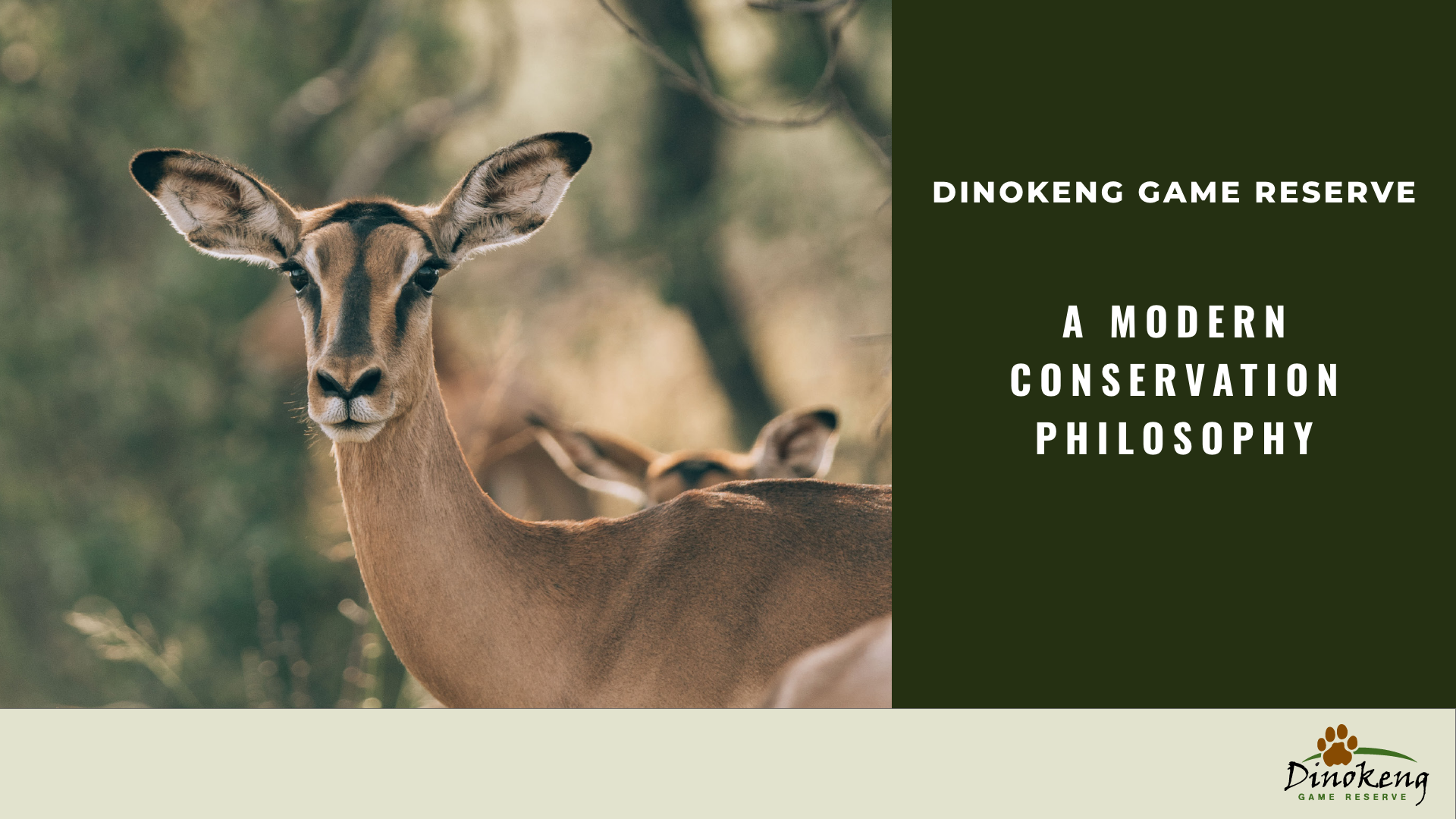
By Marius Fuls (B.Tech. Nat.Con.) Wildlife Monitor: Dinokeng Game Reserve
“What we have to do is to get all the people out. Everyone – apart from us, because we know what’s going on. Then we set hard perimeters – preferably using wire fences. We keep the animals inside in that way and separate them from other humans, because it is more natural. People can then pay us to see the animals, but under our rules and laws. Those who come in without permission get a fine or are thrown in jail. And we will decide who may benefit from the plants and animals inside. People will really appreciate and support this ideal way to protect nature!”
Conversations like these were common around the turn of the 19th century in western countries. Space was plentiful, and wildlife often still considered a pest or an infinite resource to be used under little if any regulation. African wildlife was largely unknown in western countries and a novelty to most people. Remember – television and the internet were still many years in the future… As a result, the concept of what we today call “Fortress Conservation” gained rapid popularity. People realised that this created an opportunity to separate them from the evils of nature and sooth their conscience by knowing that their actions outside conservation areas will not cause any damage to nature. After all – knowledgeable people will be looking after nature ‘in there’, and if the public want to, they can safely go see the animals at their leisure.
If your hair started to rise by now, you can easily be forgiven. After all, the picture painted above is far removed from what we know should be done to conserve nature today. Yet, fortress conservation is still practiced widely, and it has had some very positive results. In times when wildlife was not appreciated for its intrinsic value as it is today, most forms of conservation that did not involve a fortress mentality to a larger or lesser extent would likely have resulted in the depletion of a resource. Humans simply do not protect something that it does not value. Neither does it conserve resources that are in abundance. Fortress conservation saved a lot of what we have left today. It further created a secluded and isolated place where we as humans could systematically learn and understand nature and the systems that function within it better. Here I am obviously referring to intensive environmental research since the middle 1900’s that resulted in a rapid increase in our knowledge about nature.
Luckily, as we learnt more, we realised that we have not always applied the best methods of conservation, despite our best efforts. We also realised that the historic philosophies of conservation might not be generically applicable or suitable to the changed environment we are living in today. One of our biggest realisations, although it is a realisation that is not very common amongst the general public, and not very popular amongst old-school conservationists, is that we managed, unintentionally, to alienate the majority of humankind from nature. It is a fact that the closest contact most people on this planet have with nature are their pets! And popular wildlife programs on television are supposed to fill in the gaps – sadly, usually by sensationalising nature. It depicts the ‘world’s most dangerous’, or ‘most poisonous’, or ‘deadliest’ creatures. These are topics that sell well, while it effectively neglects 99% of the reality of nature and confirming the public’s misperception that nature is only dangerous, deadly, and therefore best avoided.
Just think about this: South Africans love going to the Kruger National Park to see wildlife. Most of them would be too scared to leave their vehicles (even if they were allowed to), or sleep with their tents or chalet doors open, because wild things want to kill you. If not a menacing snake or malicious scorpion, then a man-eating lion or deadly hyena! Yet, the most dangerous thing these tourists do, and will happily do again without a second thought, is to drive a car on a narrow tar strip to get to the Kruger Park and back home, missing each oncoming vehicle by only a few meters at a combined collision speed of 240 km/h! But we are used to driving on highways.
We know the risks, know how to mitigate them, and have been exposed to them daily. The fact that more people die in one bus accident on our roads than in all wildlife-related deaths in a year (malaria-carrying Anopheles mosquitos excluded) does not bother us, because it is not a foreign thing to us.
So, inadvertently, the way conservation was practiced in the past contributed to the difficulties we have in conservation today.
As long as nature and wildlife remain a novelty to an exclusive portion of a population, and poorly understood and appreciated as a critically valuable resource by most people, we will always struggle to justify expanding any conservation effort, and support of conservation initiatives will largely be done as a form of philanthropy and not necessity. But how do we change that? How do we move away from an exclusive fortress conservation model? The answer lies, naturally, where the most wildlife is left. Africa!
Fortress conservation may be dominating the South African conservation landscape, but it is not as common in most other African countries. Yes – there are reasons for this – often very justifiable, and there are benefits – often very beneficial. But Africa has more people per capita who are still in touch with nature than the other continents. People have always been part of nature in Africa, and therefore generally understand and appreciate nature much better than in most other parts of the world (South America probably coming in second). This is because people were not generally and actively divorced from nature in order to protect it. Conservation happened around, amongst, and critically, because of people, which brings as neatly to Dinokeng Game Reserve: the only residential “Big-5” game reserve in a metro and within city limits in the world.
Although several elements of fortress conservation are still, by necessity, present in Dinokeng Game Reserve, the reserve is bridging the gap by being a fortress in which not only wildlife occur, but in which people (and I am not referring to tourists) are allowed and welcomed. Nobody had to be evicted to create 20,000 hectares (and growing) of conservation space. All that was needed was progressive and openminded thinking, crossing traditional conservation barriers, challenging established philosophies, and believing in a model that can serve as a case-study for modern conservation. The reserve has created business opportunities for many landowners, mostly in the form of eco-tourism. Some landowners who chose to just remain residents in the reserve have seen the value of their properties increase. The local neighbouring community is drawing benefits in the form of business opportunities and employment.
Conceding that Dinokeng Game Reserve is not, and can never be, everything to everyone, and that a lot more can, should and are planned to be done, it is a step in a new conservation philosophy direction. Few reserves have achieved in its first thirteen years of existence what DGR has achieved. From relatively poor farmland, it morphed into a successful, growing and participative conservation estate.
The fact is that there is not, particularly in South Africa and in most countries outside of Africa, large open wild spaces available to establish Kruger National Park or Yellowstone-type conservation fortresses anymore. In as much as we treasure and cherish these wilderness areas, we need to look at spaces where humans and wildlife can successfully be integrated if we want to expand the extent and diversity of the worldwide conservation estate. Just as one ant cannot make any meaningful change to a landscape, Dinokeng Game Reserve cannot change the future of conservation on its own.
But just imagine what a colony of ‘Dinokeng ants’ can do. DGR is setting a benchmark of what is, in my opinion, one of the most progressive conservation models in the modern age. Gone are the days when humans were seen as intruders in nature. Unless we strive to make humans participants in nature, we will never fully appreciate its value, and therefore never prioritise its protection.
Nature does not need us – we need nature. Humans are curiously the only species on this planet that develops to its own detriment and actively tries to go extinct! Luckily, through our resilience and fortitude we have avoided such a catastrophe thus far. Not that nature would mind the alternative. It would probably give a great sigh of relief if Homo sapiens disappeared from its biological inventory. But I reckon that would not suit us humans very well. Conservation therefore has as its core function the protection of conditions on earth suitable for human habitation. And human’s resilience and fortitude can facilitate this too – if we want.
Dinokeng Game Reserve is a novel contributor to achieving this.